Um je zamrljan, tezak, opijen. Ne mogu se probuditi. Ne mogu se sjetiti.
Zaboravljam.
Borim se. Odupirem se tezini, obmani, gustoci, mulju.
Ne uspjevam. Iznova me povlaci prema dolje.
Znam da spavam ali ne mogu se probuditi.
San u javi
Um je odsutan, nemiran, opsesivan, povrsan. Program radi sto na sat: U pogonu sam. Doing, doing, doing. Sto je sljedece? Jos, jos, jos. Brzo, nema vremena za gubljenje.
Sjeti se sebe.
Ego zavarava, obmanjuje dobru namjeru. Progres je nezamjetan, dok mislim da radim, samo trosim, igram njegovu igru.
Vrag mi se smije. Dok mislis da se budis, sve dublje tones u san.
Dobra namjera se vazi.
Odustajem. Ne propitkujem. Uzimam zdravo za gotovo. Jednostavno je tako.
Obiteljsko prokletstvo je force majeure negativnog naboja i kruznog usmjerenja s teznjom prema dolje.
Sve imas vec u sebi.
Tko ce, ako ne ja?
Kad gle – u pozadini – to sam opet ja.
Opet ego nesto hoce, zeli, trazi, dobiva. Jos, jos, jos. Druga strana istog novcica, vrti me u krug.
Vrag se vise ne smije. Izlaz je sada.
Izadi iz vrtuljka (ne)srece. Pusti sve za sobom. Neka bude bilo sta. Neka bude nista.
Silovita rijeka tece kroz nas, a mi ne mozemo nista.
Disi.
A wakeful dream
My dream last night.
Mind is heavy, blackened, intoxicated. I cannot wake up. I cannot remember.
Forgetfulness.
I am fighting, resisting the heaviness, deceit, density, sludge.
I have failed. I am being pulled down back again.
I know I am asleep but I cannot awaken.
A dream of the wakefulness
Mind is absent, restless, obsessives, superficial. Program is on full capacity: I am in operation. Doing, doing, doing. What next? More, more, more. Fast, there is no time to waste.
Remember thyself.
Ego is deceiving, misguiding the good intention. Progress is imperceptible, I think I am advancing, but I am just wasting, playing its game.
Devil is laughing. You believe you are awaking, but you are falling deeper asleep.
Good intention counts.
I give up. Not questioning, taking everything for granted. It’s just how it is.
Family curse is force majeure of negative charge and circular direction with a downward pull.
Everything you need you have in you.
Who will do it, if not me?
When all of the sudden – in the background – it is me again.
Again the ego wants, desires, asks, gets. More, more more. The other side of the same coin, spinning me in circles.
Devil is not laughing. The exit is now.
Exit the wheel of (un)fortune. Let everything go. Let it be as it is and as it is not.
The force of the river flows through us, and there is nothing we can do.
Lately I have been experiencing anxiety. It arises from uncertainty about the future, stays with me for a while and then subdues into the abyss of unconsciousness. Despite unchanged external events, anxiety comes and goes, teaching me how the cause and the cure are not to be found outside, but are only to be addressed through fine-tuning of the inside.
To provide a bit of context – I have been standing on the verge of quite a change. I have been working for corporates for almost 10 years and have build a great career in one of the most demanding, impactful and prestige business environments, clinging on to certainty of such predetermined path to success. However, the more I unravel myself, the more I understand walking a predetermined path is not for me – I need to make it my own. I am yearning for freedom, independency and an adventure of building something limitless in its potential.
However, the anxiety I am experiencing is sometimes paralyzing. It craves for the known, for the promises of system’s security. It opposes to the nature of things, withholding me from jumping into the abyss of the unknown. It whispers: “You are not good enough. You will never succeed doing what you like. You have to compromise.” Coming from a post-war, post-communist Yugoslavia, such conditioning is embedded in my family and cultural heritage. I grew up believing money is bad and reserved to war criminals and thieves, success only happens if you come from a wealthy family, there is general scarcity of resources and we are built to work for and not to own.
Overcoming these limiting beliefs is an evolving process, and sometimes it seems never ending. Remember the path is that of a spiral – through dedicated practice, we keep on thinning our limiting beliefs by iterating lessons again and again, until the samskara (seed mental impression) itself dissolves. The victory is embedded in the process as growth is embedded in hardships. I made this blog about cracking the code on how to unravel – and for this particular code I found there are two main formulas to remember.
Uncertainty = Freedom = Creativity
First is to understand the mechanism behind the security/uncertainty coin. Security is nothing more then attachment to the known, to our past. There is no evolution in that, no creation, no expansion – just stagnation through stale repetition of outworn memories. Our tormentor today is our self left over from yesterday. On the other hand, uncertainty is the only place where something new can happen. If we have a clear idea of what is to happen, we shut down a whole range of possibilities. But if we step into the unknown, we open ourselves to limitless possibilities of creation. It is in our willingness to step into the unknown that we find freedom.
To be willing to step into the unknown, we need to accept and detach. To accept starts with accepting ourselves (our humanity) and to detach starts with understanding who we truly are (being). From detachment comes the freedom to create – as we let go of our past and tap into the limitless potential of our being. If we can experience the being, then we can experience detachment with ease – as detachment is embedded in the very nature of our being.
Confidence + Faith = Embracing uncertainty
Second is to practice our willingness to step into the unknown. This is done by cultivating two essential qualities: confidence (in ourselves) and faith (in universe). The first element – confidence – in my native language translates as self-reliance. In other words, to be confident for me means to be assured I can rely on myself in any situation. It is a combination of deep, peaceful feeling in my body and a clear intellectual understanding of the reason why. The feeling is of integrity, smoothness, lava like density and melted gold. The feeling supports intellectual understanding in a way it integrates it into our psychology by forming a new, positive belief and changing our responsive habits. There is a difference between mere intellectual processing of reason why I should be confident and integration of that reasoning into a new belief – and the difference lies in the feeling. The reason why (for example, my virtues, past achievements and skills) serve as a raw input, as the feeling then transforms it into a clarity of insight and finally forges it into a new belief. (To get a guidance on how to find the feeling, check the end of the post.)
The second element to embracing uncertainty is to have faith. To cultivate faith is to cultivate ishvara pranidana, our connection and surrender to the Source. For me, this happens two-folds. Firstly, I am re-discovering my faith through playful connection with different deities. All these deities for me represent an embodiment of a certain quality, certain sublime energy which is so pure and divine in its essence, that by finding and cultivating it in myself I remember my own divinity. Now the second layer comes in, because, guess what – the Divine IS the Source IS the Being IS You. So the next time when you practice resting in the being, try looking for that underlying connection to everything that is. When we experience awareness, we realize awareness is all-pervasive and all that exists in it is one and the same thing – is awareness itself. This insight happens when we overcome the illusion of ahamkara, the I-ness, or the primary concept of separation (I exist as an individual that is different from you). If there is no concept of I, then what is left is pure awareness without separation of the things that exist in that awareness. I do not exist as separate from you, as we both exist in our awareness. (To play a bit with the concept of separation, check the “You are the Sofa” meditation.)
By combining confidence and faith, we create a bulletproof tactic that strengthens our will to overcome whatever conditioning or negative feeling holds us back and to embrace the unknown. We become more assured that everything is gonna be alright, actually much better then alright – we understand that what awaits us is the next step in our evolution, an experience that is beyond our current capacity to imagine.
I will conclude by one of my favorite guidelines: Don’t overthink and just go into the fear. This is the very definition of courage and the only way to overcome whatever you are afraid of. Godspeed.
To cultivate confidence or any other virtue or positive belief, one first has to experience what it feels like in your body. This can be done through simple meditation.
Close your eyes and take some time to get yourself in a meditative state, either through pranayama or 10-min of breath focus meditation. It is important to get our minds a bit quieter and to be able to keep our focus steady for an extended period of time, as this skill will allow us to sink deeper into the feeling and gain insight.
Once your mind feels present and calm, focus on how your body feels, especially in the area of your first, second and third chakra. Then start repeating “I am confident”. The key is to keep your attention focused on your body, and your attitude in the position of the observer, while repeating the phrase.
Once you notice a subtle feeling in your body arising, go for it. It is as if you allow yourself – your attention – to sink deeper into that feeling, deeper into your flesh. Keep your focus on the feeling and allow it to grow until it overwhelms your attention. You will notice it has always been there, strong and present, and you just unraveled layers of noise in order to experience it more clearly.
Rest in that feeling for how long you need to get truly familiar in it and allow your process to unravel in a way that is specific to your system in order to integrate it. Whatever comes, embrace it and act on it – be it an insight, a self healing process, a continuation to different realizations or an urge to move. Finish in 10 minute savasana, releasing the experience.
You will find that it will become much easier to access this feeling on demand, even in our daily, busy monkey-mind consciousness. As a follow-up, sit and write down all the reasons why you can be self reliant (e.g. list of your skills, achievement, unique qualities, talents, education, etc.). Your intellectual understanding of the rationale behind will serve as a complementary piece to embedding your new belief and finally acting on it. Congratulations!
To experience a subtle insight on the illusion of separation, try this “You are Sofa” meditation:
Sit comfortably and take some time to quiet down your mind and enter the space, or in other words, to cultivate meta-awareness. Meta awareness is presence and awareness of everything: yourself and everything that exists outside of you. Keep you eyes opened and just notice what is around you.
Now choose one object to focus on, for example a sofa. Focus on the sofa and notice how it just exists there. Notice how your mind process the visual input of this object into a cognitive understanding how this object is what we call “a sofa” and what are its functions in relation to you.
Now notice a peculiar thing – existence of an external object in a relation to you. Notice the concept of I. Notice how it is nothing more but a concept, a thought. This concept is one of the primal components of your mind that allows us to experience and relate to the reality in the way we do, that defines us as humans. Will that sofa still be here if we remove the I? Most probably so. But it will cease to be a sofa, a concept whose functionality serves you, it will just be an unnamed object, unnamed thing that exists in the space and that you are able to perceive due to your senses.
Now notice how you can be aware of both the concept of a sofa and the concept of I. Play with the idea that, if you remove the concept of I, you remove the concept of sofa, you remove your cognitive understanding, processing and the storyline you have created about reality and all that is left is just awareness. Notice how everything just exists in awareness equally. In other words, the matter is the same, it just manifests in different forms. In other words, you are the awareness, are the sofa, are you.
Manifestation is a recent “hot topic” that I stumble upon almost everywhere I look. From articles and books to online courses and one-on-one coaching on “how to manifest your reality” – it seems like more and more people are cracking the code of human mechanism. However, it also seems like a pretty good industry, preying on the basic human desire to get what we want and avoid what we don’t want. No one can teach you how to manifest – as you are already doing that just by being human. It is one of the ground rule of the Game – our reality is a product of our mind. How you perceive your reality is directly linked to what is in your mind. The more disconnected and identified we are, the more pain and misery we experience. On the other hand, the more we unravel and connect – the more we begin to live in synchronicity and with ease.
This should not scare you – it is just how it is and sooner we accept it and take responsibility over our minds, the better lives we will lead. Human nature is based on the principle of duality – hence the “negativity” is inevitable. Hardships are great – they exist so that we can learn and grow. They burn the impurities, identifications and conditionings. They unravel you towards your true self, towards the being. You might also perceive it like this: whenever a difficult situation presents itself in your life – that is just a part of your mind expressing itself so that you can let go, heal and expand. Don’t try to avoid the negativities and difficulties – it is impossible, as this is what makes us human. Embrace the challenge and next time try to approach it from a different angle – as you know that with each new hardship, you are setting yourself free.
However, we don’t need to only go through hardships to grow and expand – we have the power to unravel our minds in a more gentle way. That can be done through deliberate self-work and practice, in whatever form serves you the best. The path of yoga is my tool of choice, however, there are so many different tools today, both formal and informal, which serve towards unraveling. The only thing you need to check from time to time is the direction – is whatever you are doing to “work on yourself” leading to less, to the being, to simplification of your life; or does it add more complexity and identification to it? For example, if I am using yoga to dismantle my belief of not being good enough, but at the same time add on this “beautiful, spiritual yoga person” to my identity – it didn’t really do much.
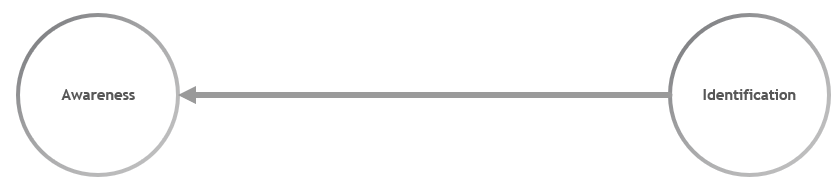
In this direction, in this path between the awareness (the being) and the identification (the ego), lies embedded the principle of manifestation. The more we move towards the identification, the more out of alignment we feel with life. We may attract hardships or feel unsatisfied, as our reality is a solid projection of the content of our unconsciousness – and we have no idea what is there. Here is where the most manifestation techniques fail – as we cannot manifest just from our conscious mind (i.e. positive thinking or endless visualization of desired outcome) if we do not know what we hold in our unconsciousness. Our conscious mind is just a tip of the giant mind iceberg – and everything else under the surface is our unconsciousness. The mere size ratio between the two is a good indicator of which part of our mind holds the greatest power – and hence manifests the reality we experience. I am not saying you cannot change your reality by changing what you think – of course you can – but that takes quite some time and effort and is pretty difficult to completely dismantle your whole conditioning that is limiting to your reality in just one lifetime. It is like trying to move a big, heavy stone sculpture by pushing it – you will need to push really hard before it moves just an inch. All the progress achieved through such manifestation techniques is marginal compared to the energy invested. What I am saying is that there is a much faster way – there is a lever to lifting your stone sculpture just in changing how you think.
First of all, manifesting something from the position of wanting it is still manifesting from desire, from the ego. Did you ever experience how, as soon as you almost give up on your desires, they all of the sudden come to you? That is because you have started to move to the opposite direction – to the direction of awareness – and by doing so allowed the manifestation mechanism of the human mind to materialize the concept in your mind. Notice the difference – before you were manifesting from the desire, the grasp, the identification – which means pain (not getting what you want) – and by moving away from the desire, by releasing the gasp and deidentifying, you released the space for your natural manifestation powers to materialize the concept you had envisioned in the first place. Deidentifying and letting go is the key. This is how you allow yourself to drift to your natural state – the state of being, of pure awareness, from which all things emerge. And the more you progress towards the being, the more you can experience (not have – as possession is identification). You can experience anything you envision (not get what you want) – because the awareness is plenty – it is all there is. By doing so, you allow life to surprise you by brining you experiences your ego-self does not even have the capacity to imagine. You experience so much more then you could have ever wanted. You surrender yourself to life – you become what you are – the vessel of the limitless creation experiencing itself. Check your direction guys, that’ all there is to it.
Being a mom is not easy. Balancing between keeping my baby happy, healthy and safe and keeping myself happy, healthy and sane is a very delicate art. I am constantly failing, learning, succeeding and then failing again; at the same time praying that her future therapy bills will at least be lower then mine. However, it is a beautiful journey and we might as well enjoy it, even with all the hardships.
As a matter of fact, the trick is in the hardships – as they provide the best platform for self-reflection and development one might ever get and thus complete the experience of parenting. There is no greater motivation then for us to grow then for the sake of our children. And as humans, we only grow through hardships.
I decided to take my experience of being a mom as a catalyzer to finally integrate some of the biggest lessons I have been sitting with for quite some time – cultivating patience, nourishing gentleness, accepting imperfection and just surrendering to what is. Here is what I am talking about:
Patience is the best remedy to every trouble
Plautus
Oh patience. The first and foremost virtue I was always struggling with. Full of energy and ideas, my way of operating is to respond to inner impulses as they arise, leaving no time or space in between. In addition, the key underlying principle of my ego can be summarized in one sentence: I want now. And I always go and get it. I also have very low tolerance for discomfort, be it physical or energetical – so (in)ability to endure peacefully is not something I would pride of. Funny enough, I have my father – as my biggest role model – as a symbol of patience. He goes through life in a strong, persistent and peaceful pace and I have never seen him get swept away by restlessness. His ability to wait patiently – be it on my mother always being late or on a big milestone event – is something I thought would never be possible for me – until I became a mom and understood this is the only way forward. If I wanted to remain happy, healthy and a content, I needed to actively cultivate the virtue of patience. That meant accepting discomfort gracefully. Letting go of some of my immediate desires and self-imposed concepts. Accepting the present with grace. Humbling down my ego. Observing and listening.
It all begins with having patience with myself. Instead of focusing on the outer source of my frustration, I tune the attention inwards and observe my inner dynamics with compassion (tip: start by focusing on your breathing during a difficult situation). In creating space for whatever arises, a clam place can be found – where I can settle as a witness and gradually prolong my levels of tolerance. Slowly, slowly, I invite patience to settle in. Through determination and perseverance we nurture our friendship – I give her welcoming space to grow and she teaches me strength and humility.
Our greatest strength lies in the gentleness and tenderness of our heart
Rumi
After ‘oh patience’ comes ‘oh gentleness’. The same restless energy that is struggling with patience is also struggling with gentleness. My dynamic is quite fast, hence my energy tends to shoot out, what can sometimes be perceived as harsh, especially by a toddler. How I would hold her, how I would talk to her or move around the space in general. Nurturing gentleness requires conscious dedication to slow down, enter the present and mindfully interact with my baby. Consciously holding the soft, compassionate space as a gentle buffer for her experience and crystallizing this field through soft touch, voice or gaze.
Through cultivating such subtlety of interaction, it gets easier to read more profound cues and understand what exactly your baby needs. It also contributes to her confidence in exploring the world on her own – as she believes world is not just a safe but also a gentle place to play in.
One of the basic rules of the universe is that nothing is perfect. Perfection simply doesn’t exist. Without imperfection, neither you nor I would exist.
Steven Hawking
Oh patience. Oh gentleness. Oh imperfection! Striving for perfection is impediment to growth. It can always be better and it will never be good enough exists only in our minds. Realizing this and letting go of perfectionism was my first step towards self-love and acceptance.
I have spend so much time and energy trying to get things perfect, be perfect, outperform or succeed. And no matter how many times I succeeded it was still never good enough. I would also take great pride in this commitment to “excellence and growth”, however completely oblivious that I am just looping over an ego-imposed concept and not really growing at all.
If perfection is our goal, we set ourselves up for failure. How our ego defines perfection is in a complete opposition to the nature of things – just the way they are. Becoming a mom was a great reflection point for me to finally accept my faults and failures for what they are – inevitable but equally valid as all my virtues and successes. This was possible only once I stopped judging – first myself and then others as well. I decided to love all the weak and dark parts of me and that is when I understood the power of self-integrity, compassion and forgiveness. In the end – nothing is perfect and nothing is imperfect – things are just the way they are.
If you surrender to the wind, you can ride it
Anonymous
To cultivate patience, nourish gentleness and accept imperfection were all key milestones to the greatest art of all – surrender. Only when you surrender to the wind, you can ride it. You can ride the great wave of life in all its immenseness, awe and beauty. You let the life take you to places that you wouldn’t even imagine before. You let things happen to you and align with synchronicity. You let the universe express itself through you. You take part in a constant dance of creation and destruction, remembering who you really are – not just the part of the whole but the whole itself.
With an overflow of different “spiritual” paths and techniques on the “market” today, it can be particularly confusing to both experienced and new minds when deciding on which road to take. If you bring into the equation general recommendation to stick to one school – as constant jumping between is impediment to real progress – one may feel lost and eventually demotivated from cultivating dedicated practice.
We should start by aligning on the ultimate “goal” – which is that of liberation. There are different paths that lead to liberation, however, there are even more paths that lead nowhere. In order to differentiate between those, one needs to cultivate a meticulous habit of keeping the ego in check. Ego will play all tricks up its sleeve in order to avoid its own dissolution – and liberation implies dissolution of the ego.
The direction of any true practice is toward untangling the layers of illusion thus overcoming the false sense of self.
p.s. ego = the false sense of self
Although it is still an over-simplified statement, it does provide a good baseline for doing frequent checks while we progress, in order to make sure we are on track. We want to make sure of the direction we are heading. Is my practice lessening the grips of my conditioning and identification withtemporary concepts that the ego mistakenly takes for its own identity, for the big “I”? Or is my practice driven by the ego itself?
These frequent check-ins are necessary because the more we practice, the trickier ego gets. For example, you might start to practice due to some form of dissatisfaction or negativity in your life. As you progress, you may start to feel better about yourself and notice how your life is changing accordingly. Although that is great, it is still not the point, and that is when we should become extra careful, as it provides for a fertile ground for strengthening yet another aspect of the ego – its identification with spirituality.
So-called “spiritual ego” is a chronic condition of 21st century spiritualism. It is a trap that awaits for all of us that are on the path and if we are not aware of the challenge, we will most likely fall into it. How does this happen? Well, instead of stripping the “I” and deidentifying from the concepts, ultimately accepting its impermanence, we do the opposite – we continue to add more concepts to it. Now we are “getting there”, we are “good”, if not even “enlightened”. We “understand how things work”, we have the “solution”, the “remedy”. Our path is the “right one” – and very often, other paths are “lesser” or even “wrong” (hello religious wars and prosecutions!). And what is especially dangerous here, our practice starts to dissolute, eventually loosing its purpose and becoming a mere playground for the games of the ego. Our paths suddenly lead nowhere, but we still believe we are heading there and that we are doing the work.
I have personally wasted several years of my practice doing “work” that was not that, but just the ego entertaining itself. I would sit in what I believed to be meditation and indulge in various “visions”, getting completely lost in the story in my head, just the ones within the “spiritual”, “ethereal” genre. There was also a period in my ashtanga practice when I was focusing solely on asanas, wanting to conquer the next asana and then the next asana (Gotta catch ’em all, Pokemon!) and feeling so good about myself afterwards. It took some turmoil to realize that even yoga will only strengthen what isinside – and if I don’t keep my ego in check, it will just strengthen the ego.
What really made a difference is to change the perspective and focus on meticulous inner observance of concepts and identifications. Observing the voice in my head, realizing it is just that – a voice in my head – and taking space from it. Observing how the ego comes up with different concepts, identifies with them and then adds opposing concepts to the initial concept it created, causing inner distress but basically just entertaining itself. Loosening the great self-importance. Deidentifying with the roles and storylines. Stopping to take myself so serious. Lessening the judgement towards myself and towards the other. Accepting what is. Being present. Strengthening the awareness (Gurdjieff’s “remember thyself”) and tapping into space consciousness.
Any practice that guides you and/or gives you tool to cultivate such perspectives is more likely to point towards liberation then the one that keeps on inflating the ego under different “spiritual” concepts. For example – the traditional Buddhist and yogic meditations in which we aim to strengthen our presence by cultivating focused and prolonged attention on the anchor object of choice (breath / body sensations / mantra / etc.), observing the thoughts as they come and go and not engaging into them – evidently cultivate healthy perspectives helpful towards liberation.
In general, we should strive towards tradition and simplicity in practice, performing frequent sanity checkups. Here is a three-point self-check I tend to do before and while doing any kind of practice:
Is this here, rather then there?
Is this less rather then more?
Is this Being rather then I?
Remember, the ego is tricky but quite predictable. As long as it is some form of “I-ness”, it is still there, creeping in the dark and waiting for the opportunity to strengthen its position. Yes – it is the general condition of humanity and hence necessary for operating in this reality – however, we should still keep it healthy and in check. So when choosing your path and your practice, make sure to often go back to the baseline and be ruthlessly honest to yourself – am “I” really doing the work or am I just kidding myself? It will save you energy, time and money and ultimately bring simplicity and ease into your life. And finally, once you realize how everything is just a grand joke, I promise you will laugh like never before.
Understanding yogic concepts is a life-long process, one that is tightly related to the energetic principles of human progress. As we progress on the path towards liberation, our insight gradually deepens, refining our understanding of the nature of reality.
The Path is that of a Spiral – hence we are not moving in circles, but rather going upwards.
While studying certain yogic principles (or any other teachings pointing towards liberation), an allegory of peeling an onion is often used. With each step we climb, we peel one more layer of our clouded perceptions, allowing the light of the being to shine through. Our minds become clearer and so does our cognitive understanding of reality. In other words, we gain the ability to observe the same concept from a new angle and hence deepen our understanding of what this really means.
I particularly like how this connects to the principle of philosophical thought that supports many different perspectives to the same object and holds them all as equal. However, the full understanding of that particular object can happen only once all of them are integrated. There are many different (and sometimes opposing) truths, yet they are all equal parts of the One. To put this in practice, let’s take a look the concept of Tapas in Yoga.
My understanding of tapas has developed over last 10 years, and will continue to do so over future years and lifetimes. My first encounter with this concept happened through my yoga teacher Marco during our studies of Patanjali Yoga Sutras. There it is written (following quote and translation from the commentary by Sri Swami Satchidananda):
Accepting pain as help for purification, study of spiritual books and surrender to the Supreme Being constitute Yoga in practice
To be frank, when I first read this – I had no idea what it means. I was trying to understand it intellectually. My first perspective of tapas is that it meant exactly that – pain, austerity or hardship. At the time I was going through the hardships that were more gross rather then subtle, encompassing multiple aspects of my reality. Enduring that pain was in a way my first step towards liberation – as I understood how the pain is just the pointer to the things that need attending and how the only way to heal was going through it.
Through attending to some of the gross chunks of my conditioning, the grip of suffering loosened (a bit). I was inspired by the shift in my mind towards more clarity and peace. I could approach “old” yogic principles from a new perspective. Hence my understanding of tapas also shifted. Now tapas became the critical principle supporting my practice. Now tapas meant discipline. Overcoming inertia and resistance. Getting up every morning at 5:30am to do my Ashtanga practice. Changing my lifestyle accordingly. Sitting everyday in vipassana for at least 20 minutes. Committing every single dime and minute of my free time to the practice.
Through this discipline, I was able to grasp the concept of “inner heat”– yet another layer of the meaning of tapas. In this context, tapas means “to burn, to create heat” – as through heat, through fire – the impurities are burned and the veil of conditioning is further thinned. This concept can be grasped through experiencing the power of Tristana (Ujjayi, bandhas drsti) in Ashtanga yoga, or through the practice of Pranayama where the fire of breath is burning physical and mental impurities.
Through consistent practice, my experience of tapas becomes more subtle, more refined – and easier to be applied in everyday life. In this perspective, tapas is the space of “internal friction”, forging you in its fire like a blacksmith is forging steel. It is that space inside you where you are enduring and accepting discomfort patiently, surrendering to What Is. And it can be accessed anytime – allowing you to practice in all areas of your life. It can be found in that final push you do in the gym (forging your endurance and strength). It can be found in finding the will and the energy to attend to your child’s tantrum after a particular long day at work (forging your calmness and patience). It can be found in resisting that delicious birthday cake as you have committed to a certain nutritional plan for a month (forging your willpower and health).
While studying the broader applicability of Tapas, I have also encountered similar concepts (under different names) in both Jungian psychology as well as the work of G.I Gurdjieff. The following excerpt is from the book Women who Run with the Wolves, describing how tapas is understood through the lens of C.G Jung:
So, here in this underworld orchard awaits the gathering together of those powerful parts of the psyche, both male and female. They form a conjunction. This word is from alchemy and means a higher transformative union of unlike substances. When these opposites are rubbed together they result in the activation of certain intra-psychic processes. They act like flint struck against rock in order to make fire. It is through the conjunction and pressure of dissimilar elements inhabiting the same psychic space that soulful energy, insight and knowing are made.
Clarissa Pinkola Estés, Women who Run with the Wolves
This “conjunction and pressure of dissimilar elements” is exactly that space that in yoga we call Tapas. What is created, what is forged out of that space, is created with Soul. Furthermore, G.I. Gurdjieff adds additional perspective to the same concept:
Fusion, inner unity, is obtained by means of ‘friction,’ by the struggle between ‘yes’ and ‘no’ in man. If a man lives without inner struggle, if everything happens in him without opposition, if he goes wherever he is drawn or wherever the wind blows, he will remain such as he is. But if a struggle begins in him, and particularly if there is a definite line in this struggle, then, gradually, permanent traits begin to form themselves, he begins to ‘crystallize.’
G.I. Gurdjieff
Gurdjieff also chooses the word “friction” – one that is created through inner struggle of natural oppositions. As we (gracefully) endure through such struggle – not giving in to the things that are not serving us and rather choosing the right thing – we begin to crystallize. In other words, our it is our ego, our mind that begins to crystallize, so that the light of the Being can more easily shine through.
To conclude, the concept of Tapas is not just limited to your yoga practice. It is relevant for all aspects of our lives. Wherever we go, whatever we do, it is in that space of inner friction where all good things are made. Remember that next time you are struggling with your willpower and motivation to stick to something that is hard but good for you. Just by going through that space in your mind, you will realize benefits that are far bigger then just the most immediate effects of that particular challenge. You will burn the impurities, you will crystallize and you will create Soul. What more can you ask?
Householder yoga series is a set of practical tools rooted in yogic tradition to help moms build up their daily practice amidst their new role, busy schedules and limited time for themselves. Each tool is integrated in the regular daily activities you are already doing with your baby, in a way that it builds on and expands the mom-baby relationship to directly serve your growth and development. The aim of this practice is to cultivate more awareness, enhance your wellbeing and integrate the power of motherhood; as well as to collect precious moments and have some fun with your baby.
Metta (or loving kindness) meditation is a beautiful practice from the Buddhist tradition, that aims to cultivate kindness and warmth towards the other. It evokes a loving, warm feeling – which is then gradually expanded by repetition of specific, benevolent phrases.
I personally love how it complements and easily builds upon the unconditional love that we feel for our babies. Hence I introduced Metta meditation in our daily mom-baby routine – as it comes rather natural to tap into the space of loving kindness and expand it beyond the mom-baby bond.
Metta meditation can be practiced in slightly different variations. As a part of our Householder yoga series, where our practice is deliberately introduced and intertwined throughout our daily routines, I kindly suggest to repeat the phrases out loud, so that your baby can also benefit from the loving kindness we aim to cultivate. Here is a detailed guide on how to practice Metta meditation with your baby:
Set up a designated time to practice (app. 20 min). I usually do it in the afternoon, when we are on our own and can relax without interruption.
To ease into the present moment, take couple of deep, slow breaths. Try to slow down your exhalation. Just take a few moments there to connect to the present through your breathing, acknowledging your existence in the space.
Metta is always first practiced towards oneself. The premise behind is: we cannot love others unless we love ourselves first. Start by acknowledging your good intention, your good heart. How great it is that you decided to carve up time for this beautiful practice. How great it is that you decided to share the loving kindness with your baby. How great it is that you are willingly expanding it for others. Then, slowly and steadily repeat following phrases (out load):
May I be safe.
May I be happy.
May I be healthy.
May I live with ease.
Loving kindness is build upon the intention of wishing good towards ourselves and other. This intention is expressed through the phrases we use – hence the phrases become our anchor. If feelings of love, warmth, kindness and friendliness arise in your mind body, connect to them, allowing them to grow as you repeat the phrases. What can help is to focus on your heart area, or even to use some crystals (e.g. rose quartz).
Now dedicate loving kindness to your baby. Repeat the same phrases out loud, fully focusing on your baby, aiming to convey these beautiful feeling of love, care and devotion. You can repeat the phrases several times, until you feel how your baby has soaked in these beautiful vibrations.
May you be safe.
May you be happy.
May you be healthy.
May you live with ease.
As a final step, we expand the loving kindness to our wider surroundings, in four easy steps:
Think of a loved one (other than your baby) – it can be a member of your family, a friend or your pet. Repeat the phrases above and continue to expand on any feeling of warmth and benevolence that might arise.
Then think of an acquaintance – a colleague, a neighbor, lady at the supermarket… Again repeat the phrases and build upon the feeling.
Now, think of an “enemy” or a person that did you harm. Connect to the good intention, to the good heart. Remember that more unconscious we are, the more we suffer. Try to find the compassion and forgiveness for that person and send them loving kindness by repeating the phrases above.
Finally, expand the good intention, expand the loving kindness towards the rest of the world. Finish with following phrases:
May all beings be safe.
May all beings be happy.
May all beings be healthy.
May all beings live with ease.
Take couple of moments to acknowledge the beautiful, benevolent energy field you have created for you and your baby. Store that feeling of loving kindness in your heart and remember it is easily accessible for you at any time, not just during the formal meditation practice. You can always leverage the mom-baby bond to feel the connection more easily and hence tap into that space where we share the loving kindness towards all living beings, as we are all ultimately one.
Freedom comes in many shapes and forms. It can be found in colors of the sunset, smell of the forest after the rain or sound of child’s laughter. It can be felt with your bare feet touching the Earth or while gazing at the stars. It can be pursued outside, however, it can only be found inside.
Freedom is a state of mind – a mind that is liberated from the grip of its conditioning. To arrive there means to understand there is nowhere to arrive. It takes many lifetimes, yet it happens in the split of a second. Several paths lead to freedom – the path of yoga, Buddhism, grace, devotion, loss and restoration…
Today I want to write about loss and restoration – and not just any, but those typical to “modern” woman – loss and restoration of her intuition and instinct.
Although the definitions of intuition vs instinct differ, both are deeply interconnected. Intuition is a deep, intrinsic knowledge without obvious deliberation. Instinct is a natural tendency to behave in a particular way. Both arise from the same place and both are languages through which the soul speaks to the mind.
If not nourished enough, both intuition and instinct can subside into deeper layers of our being, widening the gap between the ego (identity) and the self (essence). The wider the gap, the less are were in alignment with life. We may experience a series of unfortunate events, missteps or failures, all seemingly out of our control. On the other hand, if the ego is a vehicle of the self, we will be in alignment with the universe, effortlessly navigating this reality according to the soul input. Our ventures will flourish, as we will create and live with ease.
Two factors precede withdrawal of intuition and instinct – culture and conditioning. Our western culture is especially repressive to these intrinsic abilities. Analytical thinking is clearly favored to intuitive feeling, humans (and especially women) are required to adapt to linear measurement of time, contrary to their cyclical nature, and we are exposed daily to externalities harmful for our optimal mind-body balance. The mainstream life of “modern woman” is taking her further and further away from her wild, intrinsic nature, as it requires adaptation to predominantly masculine ways, in exchange for societal approval and acknowledgment. However, the main hardship to overcoming both cultural as well as personal obstacles to restoration of one’s intuition and instinct comes through our conditioning and subsequent refusal to face our fears.
Let me tell you a story of a young girl in her mid-20s. Still in her maiden archetype, she was still quite inexperienced and somewhat oblivious to the “dangers” of the real world. On top of that, she never received proper guidance nor had the opportunity to hear the wisdom of older, more experienced women – the system around her was just not set up that way. Her mother, as too many mothers today, was also oblivious to the same dangers – and she was never educated to understand her role in guiding her young. The sisterhood around her was still under a spell of rivalry, with women advised to perceive other women as their adversaries, rather then embrace them as sisters.
One day the girl was walking down the street and bumped into a tall, dark stranger. She thought nothing special of him, so she briefly mumbled the apology and continued her way. Next day, she was walking down the same street and bumped into the same guy again. This time she looked up, smiled to the coincidence but still continued her way, her mind being preoccupied with so many other things. The day after, she was again walking down the same street, except this time the stranger bumped into her. She stopped, looked up and felt a slight, trembling contraction in her gut. Before having time to acknowledge the feeling in her body, she got distracted by his hypnotizing words penetrating her mind. Third time is a charm.Can I buy you coffee?
Before she new it, they were already on a third date. She couldn’t quite read him yet, however, she thought it made him even more mysterious and attractive. That slight contraction in her gut was trembling faster, however, she mistakenly took it for excitement. He was persistent in courting her – showering her with attention, buying her presents and taking her to exciting weekend getaways. He was quite handsome and even more charming, and the sex was A-mazing. So with the first signs that something was off, she willingly decided to look into another direction – the direction of her hopeful expectations and the fairytale she always longed for. So what if he is a bit controlling? That just makes him more “manly”. So what if he is a bit coldish? I am sure I can help him open up to love.
Days turned into weeks and weeks turned into months. Slowly but surely, she was sinking deeper and before she knew it – she was in deep over her head. What started as “a bit controlling” and “a bit coldish” unraveled into total dominance and complete emotional detachment. He was taking over her life, feeding on her energy and preying on her low self-worth. She was stuck in the victim mentality, completely unable to escape his mind games. She deliberately decided to repress the feeling in her gut, over and over again, convincing herself things are going to get better, only if…
But only ifs never happen. Things never change – men like this never change. They are manipulators and predators, for whatever sad reasons. The reasons don’t matter – as our job is not to save but to evade them. The reasons don’t matter – as women find themselves in abusive relationships not because of the men, but because of their conditionings and ignorance of their intuitive guidance.
We co-create such situations as they force us to face our fears and release limited conditionings. If we are willing to do so, we set ourselves free. However, if we are unwilling to face our shadows, we might stay entrapped or repeat same bad choices over and over again – until we finally decide to let go.
The role of intuition and instinct in regaining our freedom from our deepest conditioning is essential. That is why I call it The Art of Listening to Yourself. If we vow to follow that subtle voice, always and forever, we can rest assured our actions are in line with our highest selves. This is the voice of the soul (essence) and it always there to guide us, no matter how loud the voice of the ego (identity). Unfortunately, most people run as automatons, making unconscious choices based on their conditionings. However, if we nurture The Art of Listening to Ourselves, we will bring more awareness to our life decisions, consciously directing our lives towards our highest realities.
And this is how the story ends – in a lesson on restoration of a women’s intuition and instincts. No matter how deep you sank, no matter how weak you are – it is always possible to restore our intuition and restore our lives. The instructions are simple – just listen to yourselves. Just do how you feel – how you really feel, deep inside. In order to discern between the voice of the ego (loud mind chatter around desires and aversions) and the voice of the soul (subtle, persistent feeling), remember this – intuition most often speaks through your body. It is that feeling in your gut, that knot in your throat, that pain in your hips. It is subtle but persistent. Sometimes it can come from outside of the body, but the rule is simple. If we go for it, it feels good. If we ignore it, it doesn’t feel good.
I have never met a woman who doesn’t hear the voice of the intuition. No matter how subtle, it is there. It is deeply engraved in your being from the moment you were born and will continue to be there long after you die. You can hear it, you just need to decide to follow it – and your intuition will grow stronger. However, to make that decision, even when the whole world seems against it, you need to trust. Trust yourself. Or more precisely – trust the divine guidance of your soul. The universe has your back. In the end, we are nothing but the universe experiencing itself. And through intuition we can tap into that alignment, we can tap into that space. We can tap into Freedom.
Householder yoga series is a set of practical tools rooted in yogic tradition to help moms build up their daily practice amidst their new role, busy schedules and limited time for themselves. Each tool is integrated in the regular daily activities you are already doing with your baby, in a way that it builds on and expands the mom-baby relationship to directly serve your growth and development. The aim of this practice is to cultivate more awareness, enhance your wellbeing and integrate the power of motherhood; as well as to collect precious moments and have some fun with your baby.
If you hit a wall, climb over it, crawl under it, or dance on top of it.
Being a mom is great. It empowers women as we finally realize the magic we are capable of. It refines our intuition and develops superpowers to raise and nurture our babies, create and express ourselves, as well as deepen the connection with worlds both outside and inside of us.
One of the superpowers I especially love is the drive to reinvent things on a daily basis, striving towards simplicity, practicality and meaning. In other words, for a mom (or for any other human, really) – there is no more capacity for bs. What we spend time and energy on should only serve and nourish our souls.
In light of the aforementioned – one of my favorite things to do with my baby is to dance. She loves the music and she loves to move. I enjoy performing for her and she enjoys being entertained. Besides being super fun, introducing dancing in your daily mom-baby activities can:
Promote bonding through a super fun way
Support your fitness, in light of the limited time you can dedicate to yourself
Help move the energy throughout the body and release any stored emotions or even trauma
Help your self-expression, creativity and processing emotions
Support motoric development and movement coordination of your baby
As I was a professional dancer for many years, my body craves dancing. Hence to introduce dancing in our daily mom-baby routine came rather naturally. However, if you need some help how to get your body moving, here is how:
Prepare: It helps to set a specific time for dancing that fits in your daily mom-baby routine, in order to build the habit. Then commit that today at xx:xx hours you will show up for yourself and let it flow.
Bring awareness to the body: Put your favorite music on and start by slowly moving the body. You can follow the simple exercise below in order to wake up the body, as often practiced in creative movement and improvisation sessions.
Start by observing and becoming aware of your right arm. Look at your fingers, palm, forearm, upper arm and the shoulder. Start to slowly move all those different parts of the arm, exploring the range of movement in your joints. Play with all the different directions of movement, as well as with isolating a certain part of your arm vs moving the whole arm together. Ask your arm what does it feel like doing today, how does it feel like moving?
Keep the focus on the right arm for couple of minutes and then proceed to the left arm. Do the same with your left arm, engage it through reviving different parts of the arm and exploring different ranges, directions and combinations of movement. Then do both arms together for a couple of moments and play with how they dance together – do they follow each other, dance at the same time or can they do completely opposite things?
After couple of minutes, proceed to the trunk: start from shoulders, through your chest, belly, back and pelvis. Apply the same logic – explore different ranges of movements in each of these parts that together form your trunk. Pay specific focus to the chest to open your heart, as well as to your pelvis to awaken the life force. Imagine you are in tribal mode and just shake your trunk. Stay here as long as you like.
Now proceed to the hips and explore the range of movements in your hip joint. Hips are where our bodies like to store different unprocessed emotions, so be gentle and do not be afraid to go deep. Then follow the movement down your right leg first: from the left hip, through the thigh, knee, shin, ankle and foot. Do the same through you right leg and eventually, move both legs together. Ask the same questions: how are my legs feeling today, how do they want to move, how they play together? Then focus on the feet and your connection to the ground. Feel the floor, feel the Earth underneath you and imagine as if you are tree and your roots go deeply into the ground through your feet.
Last but not least – move your head. Start by moving the neck very gently, in circular movements in both directions. Then let your head dance a bit, engaging all parts – hair, scalp, forehead, eyes, nose, jaw, chin, tongue, ears. After you have awaken your head and your face, it is time to move your whole body together. Keep the attention throughout your body, trying not to let any part out. Then slowly, as you catch the rhythm, let the intelligence of your body take over and just dance, dance, dance!
Be silly: No one is watching! I encourage you to dance like a child, with your child. Don’t think about how you look – you look beautiful. Being able to let go of the body image and just let the body express itself is so liberating. Laugh, jump, turn, do chicken dance – whatever you feel like. Once you bring forward your inner child, you will feel a deeper bond with your baby – as the presence takes over, immersing both of you in a playful dialogue.
Householder yoga series is a set of practical tools rooted in yogic tradition to help moms build up their daily practice amidst their new role, busy schedules and limited time for themselves. Each tool is integrated in the regular daily activities you are already doing with your baby, in a way that it builds on and expands the mom-baby relationship to directly serve your growth and development. The aim of this practice is to cultivate more awareness, enhance your wellbeing and integrate the power of motherhood; as well as to collect precious moments and have some fun with your baby.
For years now I have been starting my day with morning practice – meditation, pranayama, asana. Having a dedicated, disciplined routine helps to set my day, as well as to provide a container for consistency of inner work. After I became a mom, and especially in the first couple of months, it seemed impossible to find the time for myself, let alone to dedicate it to practice. However, as I was craving my inner peace more and more, two things happened.
First, I realized how, in the light of my new caregiver role, I don’t need to set aside a specific, dedicated time slot for when I meditate or work on myself. The meditation, the work should happen 24/7 – not just during couple of minutes/hours per day when we do our practice. Taking our practice off the mats and into our daily lives is the core of householder yoga. For example – we can cultivate focused awareness during any of our daily activities, just as we do so in meditation. As we carry out our endeavors with conscious presence, we begin to nurture the connection to the being, bringing more meaning and purpose to our daily lives.
Second, becoming a mother endowed me with beautiful intelligence supportive to the practice. I find it easier to connect to myself through the endless love for my baby, as well as to stay in the present moment through the joy she evokes in me. I have never been more motivated to practice focused awareness in order to be able to hold the space for my baby (more on that one soon), as well as to overcome my conditioning and expand my being in order to be the best mother I can be.
As a result, my morning practice evolved in a way that it builds upon our mom-baby morning routine, cherishing our connection, nurturing my baby’s development and supporting me in the work. For this beautiful morning meditation you do not have to set up designated alone time – you just need to include it in your “regular” encounters with your baby. Here is how:
Choose the activity: This meditation is recommended to do during the morning play time. However, as each mom-baby have a unique schedule, you will know best which of the morning activities you want to turn into your morning meditation. I choose playtime because it is enjoyable and spontaneous.
Prepare the space: Make sure you the two of you are comfortable and uninterrupted for the next 20 minutes. Set your meditation bell at 20 minutes for optimal timing.
Set your intention: Now, for the next 20 minutes, the goal is to stay fully present and to cultivate awareness. Decide to give your full attention to your baby while interacting through play.
Ease into meditation: You can start by looking at your baby and acknowledging your presence in the space. Observe how beautiful and magical he or she is. Listen to the sounds he or she is making. Connect to your heart through the love that naturally emerges.
Connect with the breath: Start to observe your breath. Take a couple of deep, long breaths, feeling how your diaphragm expands and contracts with each. During the meditation, the breath will be our anchor in the present moment.
Expand the awareness: As you start to play with your baby, bring awareness to every activity you perform. Be in the now. In order to give our full attention to what we are doing, we just need to observe it. It is that simple.
Keep the focus: Try to stay focused for as long as you can. If thoughts arise, just observe them come and go. If you catch your mind wandering away, gently bring the awareness back to breath first, and then expand it to whatever you are doing at the moment.
Wrap up: End by thanking your baby and your self for this moment. Remember the practice doesn’t stop here – you are invited to keep cultivating the awareness throughout your day. Just remember yourself. You can always use breath as your anchor to the present moment.
Tip – During the meditation, acknowledge the silent observer, the presence emanating deep within you, that which enables the space in which all things manifest. Whatever we do, the aim is to cultivate the connection to this part of ourselves, to our being. This is how we return home to our true selves.











 Unravel Ninja